
This is the site where we try to discern the truth of things via the use of available information, pure logic, and absolutely nothing else.
A bit of a grandiose statement, I agree, but this approach does often seem to serve me well, that is until I try to use it to get to the true nature of Special Relativity, then something strange starts to happen. Not only do I find that it seems beyond my understanding, but it appears that I have that problem in common with many of the, ‘experts’ in the field. So when I approach these people, with my confusion, they all seem to go into a sort of defensive panic. Almost as if they fear being ‘found out’?
So dear reader, I forgive you for wondering if I am some sort of Flat Earther or some sort of crank. (Sometimes I wonder myself.) All I ask is that you read on and then perhaps, if you’re smart enough, you will be able to explain to me, the error of my ways.
I hope you’re sitting comfortably. Lets begin.
I was born the year Einstein died and on the 10th anniversary of his death there was a great deal of talk about his life and his theories in the media. It struck me, immediately that the basic postulates, combined with some of the other basic tenets of special relativity appear to lead, at least as presented, directly to a number of rather strange paradoxes:
Postulate 1. The laws of physics take the same form in all inertial frames of reference.
Postulate 2. As measured in any inertial frame of reference, light is always propagated in empty space with a definite velocity ‘C’ that is independent of the state of motion of the emitting body.
Some basic tenets of special relativity.
1. That any object, in motion, will be foreshortened in its direction of motion, dependant upon its rate of motion such that achieving the speed of light is rendered impossible, as this would also require the object to become infinitely thin. Please see:
http://hyperphysics.phy-astr.gsu.edu/hbase/Relativ/tdil.html
2. That any object, in motion, will gain ‘relativistic mass’ dependant upon its rate of motion such that achieving the speed of light is rendered impossible as this would require the acquisition of an infinite amount of mass. See below:
https://www.britannica.com/science/relativistic-mass
3. That any object, in motion, relative to an observer, will experience a slowing down of the passage of time, relative to time as measured by the observer, dependent upon the object’s rate of travel. [This is exemplified by the famous twin brother thought experiment etc.] See below:
https://www.phy.olemiss.edu/HEP/QuarkNet/time.html
To demonstrate some of the resulting paradoxes, that logic would seem to indicate, and perhaps get some answers, I wrote a little quiz (I was only 10!) Years later I decided to incorporate it in to my Novel ‘Adriana’ and attribute it to a nine year old character in the book.
So here it is from the book:
Andromeda’s List of Impossible questions (age 9)

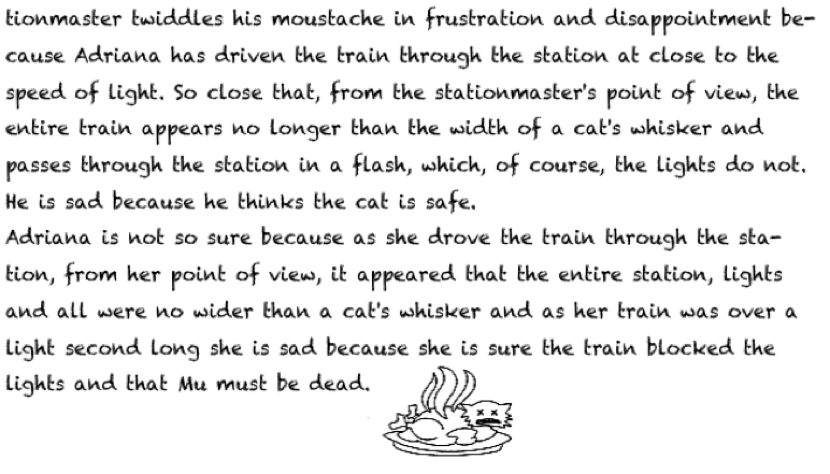
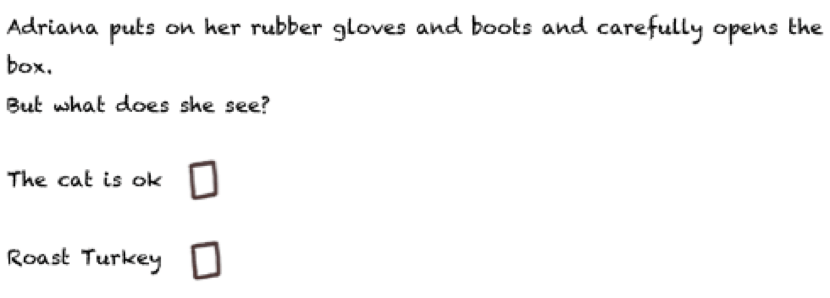
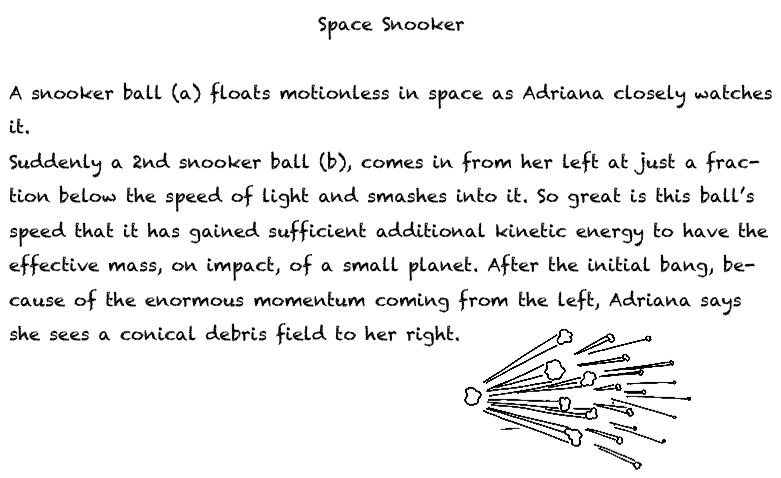
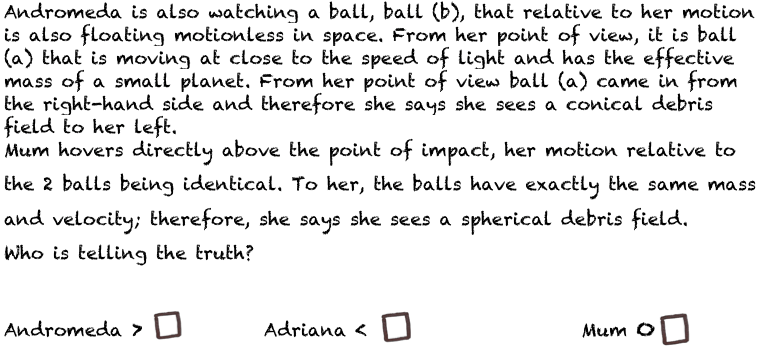
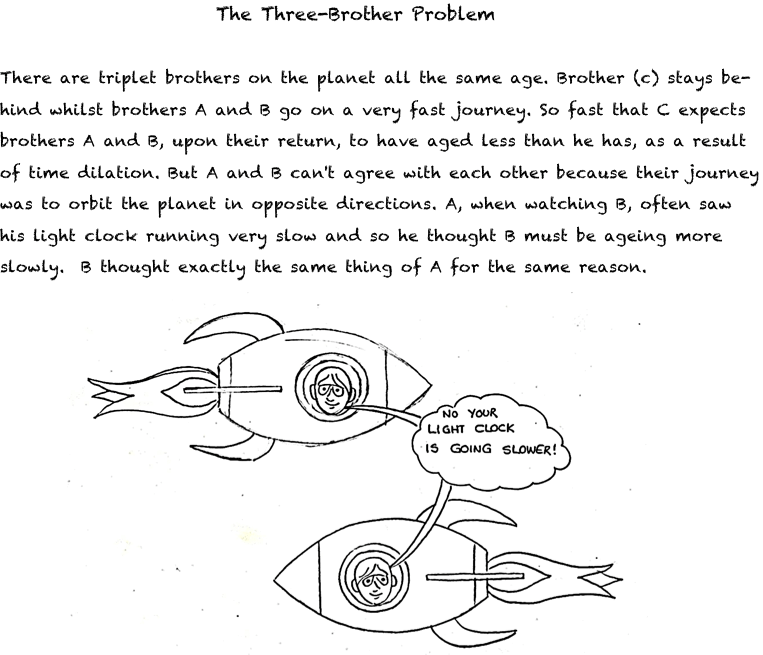
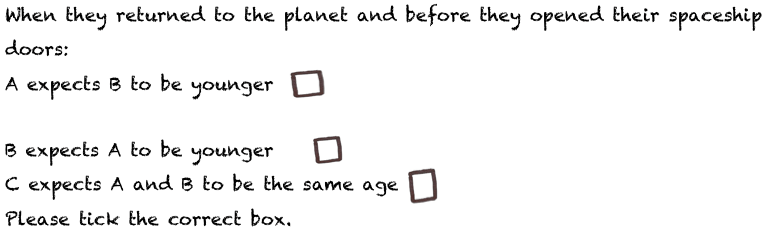
As you can see, these paradoxes relate to the basic tenets of special relativity in the same order that they are listed above. (Length contraction, then ‘relativistic mass’ and finally, time dilation.)
So why, you may ask, do I think any of this might be interesting to you. Well it is just that there seems to be some sort of blind spot within the minds of most modern physicists. For example, they offer a whole range of different explanations for time dilation and in particular the reason why the ‘travelling brother’, in the twin brother thought experiment, winds up being younger than his sibling. We have the, “all of this is because one of the brothers accelerated and the other didn’t” explanation.
https://en.wikipedia.org/wiki/Twin_paradox
Then there is the length contraction explanation:
https://www.scientificamerican.com/article/how-does-relativity-theor/
Of course there is Einstein’s own light clock on a train explanation, which requires neither acceleration nor length contraction.
https://www.emc2-explained.info/The-Light-Clock/
Strangely, people often mix in observed effects like those due to Doppler effects and time delays that, of course, would have no bearing on the relative ages of the brothers when they, once again, meet up!
The blind spot?
Well we have the tech to observe time dilation directly as in GPS satellites, at the LHC, with atomic clocks in air craft and even when checking the telemetry of a vehicle coasting on its way to the moon and back again for example. So no need for acceleration? [Unless, of course, one were to contend that the universe makes a distinction between objects that happened to have accelerated at some time in their past and those that, somehow, hadn’t!] The direction of travel can also be directly observed to be irrelevant as is, of course, direction change! (All observers see the same amount of actual time dilation regardless of their location as far as direction alone is concerned (you could send them a photograph of an on-board clock, for example.) Of course, it goes without saying that all observers would be required not to be in motion relative to one another in this instance.)
https://www.scientificamerican.com/article/einsteins-time-dilation-prediction-verified/
https://www.livescience.com/58245-theory-of-relativity-in-real-life.html
All of this seems to be considered irrelevant to those that would claim possession of the most expertise in this field. It’s almost as if they are afraid to admit that they are confused by this subject. No surprise there!
[Ok, it’s about here that many would start to shut down, but I’m hoping you are different.]
Anyway, so I’m shouting, “Ha Ha the emperor’s got no clothes on”, but maybe I’m just the fool here. I think it would be fun to find out, don’t you?
To this end I thought I might show you how one well known physicist, a man who has authored well over a hundred physics papers and articles, responded to this section, in my book (shown above). It’s a great example. So in response to the quiz and in particular to the first question (about whether or not a train blocked the lights) he states the following:
“These are well-known mental exercises in special relativity; George Gamow, for instance, had some wonderful popular science books decades ago, in which a character named Mr. Tompkins explores precisely these puzzles (https://en.wikipedia.org/wiki/Mr_Tompkins). So then, my hints: 1. the key is that simultaneity is relative. (Mr. Tomkins, as I recall, had a similar problem about a car fitting or not fitting in a garage.) Those on the train may see two signals triggered by the two ends of the train at the same time but not at the same place. For those at the platform, these two signals will not appear at the same time. For those on the platform, at no time will the train appear to be present at both sensors simultaneously. Common fallacy: people assume, based on high school formulas, that the Lorentz transformations are merely about clock dilation or length contradiction as opposed to transforming space and time together. Spatial distance translates into time and vice versa, when moving coordinate frames are considered.”
Note that here he seems unaware that this is a length contraction question and not a simultaneity problem at all. (There are no signals being observed or travelling down the length of a moving train, or anything like that involved!) The question is not about when the train did or didn’t block the lights [perhaps it would have been better if I had chosen to have just one light] but it is about whether the train didn’t or, for that matter, did block the lights at all, at any time! (If you like, you can imagine the train was a light year long etc!)
As with all these questions, the results of the relativistic effect being examined produce ‘real world effects’ that can then be observed by all, regardless of their inertial frame of reference or location. A dead cat is a dead cat to all! So no surprise then that he didn’t tick any of the boxes then!
If you are interested, I have written an example of what a ten year old me might have come up with as a simultaneity paradox question, if it had occurred to me, and it is shown later.
Moving on, we come to his response to the second question which relates to the fact that objects approaching the speed of light, in accordance with Einstein’s special theory of relativity, can be observed to have gained effective mass in direct relation to the rate of their observed motion:
“2. So sure, in the center-of-mass reference frame, the debris field is spherical. But it is evolving with time. So when you transform it into a moving reference frame, velocities change and the field becomes lopsided in that reference frame. This doesn’t even have anything to do with relativity theory.”
In this response he seems to be ignoring:
1. The simple fact that the mass of objects have a very considerable effect on the outcome of any collisions they are involved in.
2. Objects accelerated to near the speed of light can gain a great deal of ‘relativistic mass’ [there is no theoretical upper limit to the amount.]
3. An objects velocity is entirely observer dependent. Travel with an object that is travelling near the speed of light (from one observers point of view that is) and it would, for you, appear and would actually be, stationary. [‘There is no preferred frame of reference!’ Albert Einstein.]
As with all these questions, the results of the relativistic effects observed produce ‘real world effects’ that can then be observed by all, regardless of their inertial frame of reference or location. A cone of debris or for that matter a sphere of debris, would be the same for all observers. Observers who could choose to return to the scene of the collision, stop their relative motion, take a good look and then maybe even compare the videos they took of the event whist they were in motion or otherwise, as described in the question.
I got the impression he was a little annoyed by this one, but in any event he ticked no boxes!
Finally we come to my variant of the twin paradox. This question relates to the fact that all brothers would observe their siblings to be in rapid motion relative to themselves (whilst stationary within their own frame of reference) and therefore ageing more slowly than their siblings. When two brothers are considered, one can assume that, because one brother travelled away and came back and the other didn’t, the explanation for the local asymmetrical passage of time lies in this. But what if both do and what if all their movements are perfectly mirrored. Then what?
So, anyway this is how the great professor responded.
” 3. This is just another variant of the “twin paradox”. In this form, it is based on a simply fallacy, really just a cheap parlor trick: you must realize that in order for the participants to meet for a second time, at least some of them must change inertial systems en route. The numbers tell their own story, but what remains true is that between any two spacetime events (an event is characterized as a specific location at a specific time) an observer that follows an inertial trajectory measures the most elapsed time. Observers whose velocity changes between the two events will measure less time. As the extreme, an observer who leaves the first event in some direction traveling at nearly the vacuum speed of light, then turns around instantaneously and travels back just in time for the second event will experience almost no time elapsed at all. And yes, observers who follow symmetrical trajectories in opposite directions will, when they meet again, be of the same age. Hope this helps. If you can get a hold of those Mr. Tompkins books, I think you’ll enjoy them. The illustrations are delightful.”
His annoyance is almost palpable this time, although he does appear to calm down a bit towards the end.
This child’s question is ‘just a cheap parlor trick’ is it? What do you think?
Any idea what the ‘simply fallacy’ that he is referring to, actually is?
Note, he completely ignores the fact that, according to their observations, each of the brothers would expect to be, at the end of his journey, the oldest one!
Now I’m not arguing against relativity, that would be ridiculous. No, I’m just observing that these people, actually, really don’t get it! It’s as if they know everybody thinks they do and they are keen to keep it that way. Hence the responses above! So no boxes ticked and, of course, no explanation for the choice of box.
[At the risk of stating the obvious, I think I should state here that, throughout their entre journey and regardless of their direction of travel, the brothers, if they could observe each other, whilst accounting for irrelevant complications such as Doppler effects and delays etc, would, according to the received wisdom, observe his siblings light clock to be running slow! (Of course there would be an infinitely brief period when the two orbiting brothers would be following parallel paths, but the rest of the time…!)]
So, as advised, I bought and read the book (Mr Tompkins by George Gamow) and to my surprise I found no mention of any cars or garages within. I did however find a number of strange errors.
I thought that Edwin Hubble was aware that the Andromeda Galaxy was approaching us back in 1925 and I was certainly aware of it in 1965 when, by coincidence, George Gamow’s book was published; yet strangely, within the book, he clearly indicates that he thinks the Andromeda Galaxy is receding! Quite a large number of other scientific errors appear in the book that I think one might allow for, given when the book was written. There is however one, shall we call it, anomaly, which is particularly relevant to the above.
Early, in this rather childish book, (replete with talking electrons and naughty positrons) he explains that the time dilation, on an imaginary train, is as a result of the activities of the brakeman and the engine driver and therefore as a result of acceleration. Later, in the same book, he clearly ascribes it to velocity.
Now, to be clear, I am NOT saying both can’t be true, but what I am saying is that; that is NOT what is being said in the book which, in this case, rather begs the question, if it were so, then why not? So there we have it, the great George Gamow, seemingly as confused as everybody else! Do you think he would have ticked any of my boxes?
Of course, I am not saying all of science is wrong and that I’m right. No, I’m saying that what is being said by many is often inconsistent and sometimes seemingly illogical. Science, in my opinion, is all about precision; using the best available data and the purest logic, often in it’s most pristine mathematical form, to determine the true nature of something, but present this child’s questions to a physicist and, well in my experience, that’s not what you get. You see, in this reality there really can only be one correct answer to each of the three questions. Not no answer, or for that matter, multiple different correct answers either. But when I show this to one of my physicist friends I get a lot of rather nebulous generalisations backed by the, me great expert you know nothing, approach. (The sort of thing you might have got from Ptolemy or Pope Urban Vlll.)
Surly boxes ticked and precise reasoning is required here! Am I wrong?
So anyway, writing in 2023, this is what I probably would have written, as a simultaneity question, in 1965!
A girl (girl A) contrives to close and then open two widely separated switches at the same time. Another girl (girl B), because of her location and her rate of relative motion, sees first one switch closed then opened and then the other switch closed and then opened. She insists that at no time were both switches closed at the same time. She also goes on to point out that her view of the sequence of events is as valid as any other.
https://en.wikipedia.org/wiki/Relativity_of_simultaneity
Girl A disagrees because, from her point of view, both switches were closed simultaneously, completing a circuit that caused a light to flash. A flash that both girls saw!
So please tick the correct answer:
1. Girl B is correct because quote, ‘it is impossible to say in an absolute sense that two distinct events occur at the same time if those events are separated in space.’
2. Girl A is correct because, the light would only have come on if in fact both switches were closed at the same time and therefore any observation that this did not occur must be illusory.
I leave it to you to imagine the boxes!
I look forward, if any dare to respond, to what solutions to these paradoxes might be offered, but please note that only answers that ‘tick a box’ will be taken seriously!
Also note that answers that tick a box without a clear and complete explanation would obviously, also be insufficient! For example a choice of box ‘3’ in the three brothers thought experiment that didn’t explain away the observations of brother A and B , would obviously also be a fail!
(The comments icon is right at the very bottom!)
Please offer your answers here; if you find you can’t, that’s ok, there’s still fun to be had. Got any sciency friends? Want to see them in pain?


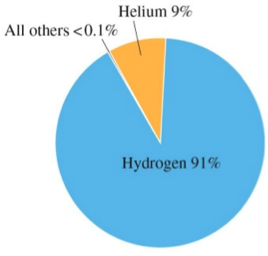
 Life uses what is available! We are mostly water, H2O!
 Whithin a huge cloud of……..err Stardust?


 The problem is that we need to be listening to what the real science is telling us, but when the so-called experts in the media talk, what in the fullness of time can be shown to be a load of old tosh, then they play into the hands of the conspiracy theorists and trumped up doubters like those indicated above. Everybody who has a vote, has a vote regardless of what they know or understand and every politician isn’t necessarily expert at anything other than perhaps making speeches. So it is important that when the voice of science is heard, it imparts clear and accurate information that we can all, always trust. Break that trust and you create a void that can be filled with the sort of dogma and ignorance that this world has been plagued with for far too long and at a time when we no longer have the luxury of simply believing whatever suits us. A time when our collective ability to understand the
  Scientists On Acid